
The 4 Horsemen of the Apocalypse are traditionally known as Conquest, War, Famine, and Death. They appear in Revelation 6, where four riders emerge as the first four seals are opened, bringing powerful images of conflict, suffering, hunger, and death.
But there is more to these famous figures than their names. Each horseman has a different horse, color, weapon, and symbolic meaning. The white horse is linked with Conquest, the red horse with War, the black horse with Famine, and the pale horse with Death. Interestingly, the Bible does not give all four riders personal names. These traditional names come from what the riders do and what they represent.
The Four Horsemen of the Apocalypse names and meanings have remained popular for centuries because their symbols are easy to understand and full of mystery. They have inspired religious art, books, movies, games, and fantasy stories. If you want to know the names of the Four Horsemen of the Apocalypse, understand their biblical meaning, or learn why their horse colors matter, this guide gives you the complete answer in simple terms.
Who Are the 4 Horsemen of the Apocalypse?
The Four Horsemen appear in the Book of Revelation, the final book of the New Testament. They arrive one after another when the first four seals are opened.
The traditional identities are:
- White Horse — Conquest
- Red Horse — War
- Black Horse — Famine
- Pale Horse — Death
Each rider represents a different kind of disaster or suffering.
The first rider is connected with conquering power. The second takes peace away from the earth. The third shows the terrible effects of food shortages. The fourth brings death on a massive scale.
Together, the four riders create one of the most memorable images in biblical literature.
The White Horseman: Conquest
The first horse is white, and its rider carries a bow. He receives a crown and rides out conquering.
Because of this description, the first horseman is traditionally called Conquest. Some interpretations use Victory instead.
The rider’s crown suggests authority, while the bow suggests military power. His mission to conquer gives him a strong connection with expansion, control, and victory.
What Does Conquest Mean?
Conquest means gaining control over another place, group, or people, usually through force.
As a symbol, Conquest can represent ambition, domination, victory, and the hunger for power.
For a fictional character, Conquest could be a powerful ruler who wants to build an empire or defeat every rival.
What Does the White Horse Symbolize?
The color white can suggest victory, triumph, authority, or purity. In the context of the Four Horsemen, it gives the first rider a very different appearance from the darker riders who follow him.
The Red Horseman: War
The second horse is red, and its rider carries a large sword. He is given the power to remove peace from the earth.
This rider is traditionally known as War.
The red horse creates an immediate image of blood, violence, fire, and battle. The sword strengthens this meaning.
What Does War Mean?
War means organized fighting between nations, armies, or groups.
As one of the Four Horsemen, War represents violence and the destruction of peace. His arrival shows how quickly a peaceful world can become filled with conflict.
For a fantasy character, War could be a fearless warrior, battle leader, or supernatural force that appears wherever peace disappears.
What Does the Red Horse Symbolize?
Red is often connected with blood, anger, danger, and violence. That makes it a fitting color for the horseman associated with War.
The Black Horseman: Famine
The third horse is black, and its rider holds a pair of scales.
This rider is traditionally called Famine.
The scales are an important part of his symbolism. In Revelation, a voice announces extremely high prices for basic food. The scene suggests a time when food is scarce and ordinary people struggle to survive.
What Does Famine Mean?
Famine means an extreme shortage of food that causes widespread hunger.
As a symbol, Famine represents scarcity, poverty, hunger, and hardship.
Unlike War, which brings direct violence, Famine shows another form of suffering. People may survive a battle but still face hunger when food becomes difficult to find.
What Do the Scales Represent?
The scales can suggest measuring and rationing food. They also help show that basic necessities have become valuable and difficult to obtain.
The black horse therefore represents a world where survival itself becomes a struggle.
The Pale Horseman: Death
The fourth horse is pale, and its rider is directly named Death.
This is the clearest name in the biblical passage. Revelation 6:8 identifies the rider as Death and says that Hades follows him.
The pale color of the horse adds to the frightening image. It is often understood as a sickly or corpse-like color.
What Does Death Mean?
Death represents the end of physical life.
As a symbol, Death can represent mortality, destruction, loss, and the final result of widespread suffering.
Among the four riders, Death is the most direct and unmistakable name.
Why Is the Pale Horse So Frightening?
Unlike the bright white horse or fiery red horse, the pale horse has a sickly appearance. Its unusual color makes the rider feel unnatural and threatening.
It creates a strong final image after the conquest, war, and famine that come before it.
4 Horsemen of the Apocalypse Names and Meanings
Here is the simple breakdown:
| Horse | Horseman | Meaning | Main Symbol |
|---|---|---|---|
| White | Conquest | Power and victory | Bow and crown |
| Red | War | Violence and conflict | Sword |
| Black | Famine | Hunger and scarcity | Scales |
| Pale | Death | Mortality and destruction | Death itself |
These are the traditional 4 Horsemen of the Apocalypse names and meanings most commonly used today.
One important detail is that these are not all personal names directly written in Revelation. They are traditional names based on the riders’ descriptions and roles.
What Do the Four Horsemen Represent?
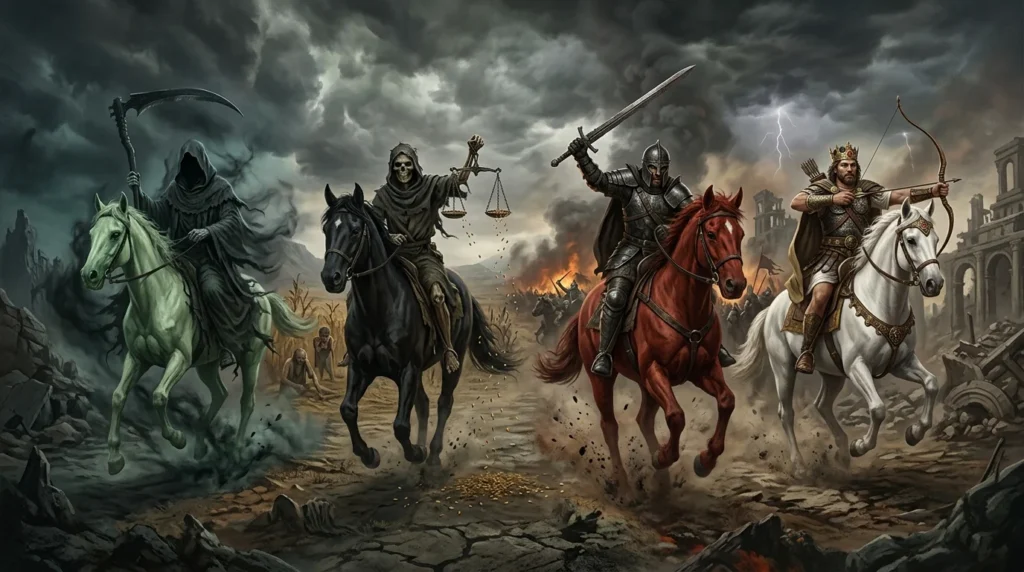
The four riders can be viewed as symbols of major forms of human suffering.
Conquest represents the desire to control and dominate.
War represents the destruction of peace.
Famine represents hunger and the lack of basic resources.
Death represents the loss of life.
The four ideas can also be connected. Conquest may lead to conflict. War can destroy farms, homes, and communities. Destruction can create food shortages. Hunger, disease, violence, and hardship can then increase death.
This connection gives the Four Horsemen a powerful sense of progression.
What Do the Four Horse Colors Mean?
The horses are not simply different colors for visual effect. Their colors help create the mood and symbolism of each rider.
White Horse
The white horse is associated with Conquest. Its bright appearance can suggest victory, authority, and triumph.
Red Horse
The red horse represents War. Its fiery color creates a strong image of bloodshed, danger, and violence.
Black Horse
The black horse represents Famine. Its dark color fits the themes of hunger, hardship, scarcity, and loss.
Pale Horse
The pale horse belongs to Death. Its sickly appearance gives it a frightening connection with illness, mortality, and destruction.
These four colors have become one of the most recognizable parts of the Four Horsemen story.
Are the Four Horsemen Actually Named in the Bible?
This is an important point for anyone researching the names of the Four Horsemen of the Apocalypse.
The Bible does not provide a simple list of four personal names.
Instead, Revelation describes what each rider looks like and what each one does.
The first rider conquers.
The second takes peace from the earth.
The third is connected with food shortages and high prices.
The fourth is directly called Death.
Because of these descriptions, later readers traditionally use the names Conquest, War, Famine, and Death.
So, Death is directly named, while the other three names are traditional labels based on interpretation.
Why Is the First Horseman Sometimes Called Victory?
The first horseman can cause confusion because different sources use different names for him.
Many people call him Conquest because he rides out conquering.
Others call him Victory because his actions are connected with triumph and winning.
The white horse and crown also make the rider look like a victorious ruler.
This is why you may see both Conquest and Victory when searching for Four Horsemen names.
The traditional list most often used today is Conquest, War, Famine, and Death.
The Four Horsemen in Art and History
The Four Horsemen have inspired artists for hundreds of years.
One of the best-known examples is The Four Horsemen, a famous woodcut by Albrecht Dürer created in the late 15th century.
The artwork shows the four riders charging forward together. Their dramatic movement helped turn the biblical scene into one of the most recognizable images of the Apocalypse.
Since then, artists have continued to create their own versions. Some make the riders terrifying and realistic, while others give them a fantasy or supernatural appearance.
The Four Horsemen in Modern Fiction
The Horsemen are also popular in modern entertainment.
They appear in fantasy novels, comics, television, films, video games, and artwork. Writers often use them as powerful supernatural characters.
Their traditional names work especially well because each one immediately suggests a personality.
Conquest sounds ambitious and commanding.
War sounds fierce and aggressive.
Famine sounds mysterious and dangerous.
Death sounds dark and unstoppable.
Some modern stories replace Conquest with Pestilence, making disease one of the four major forces.
However, Pestilence is a later interpretation rather than the direct name of one of the riders in Revelation 6.
Mythical Figures Similar to the Four Horsemen
The Four Horsemen are sometimes compared with powerful figures from other mythologies.
Thanatos
Thanatos (THAN-uh-tos) is a figure from ancient Greek mythology associated with death.
He is not one of the Four Horsemen, but his role makes him an interesting comparison.
Hades
Hades (HAY-deez) is connected with the Greek underworld and its ruler in Greek mythology.
Hades is also mentioned in Revelation 6:8 alongside Death, but he is not one of the four horsemen.
These comparisons show how different cultures have created powerful symbols around death and the world beyond life.
Powerful Names Inspired by the Four Horsemen
The traditional Horsemen names can also inspire fictional characters.
Conquest
A strong name for an ambitious ruler, emperor, or warrior who wants control.
War
A bold choice for a fighter who represents battle, anger, or conflict.
Famine
A mysterious name for a character connected with scarcity, survival, or a dying world.
Death
A dramatic name for a supernatural, immortal, or unstoppable character.
These names can work especially well in fantasy, dark fiction, mythology-inspired stories, and role-playing games.
Why Are the Four Horsemen Still Famous?
The Four Horsemen remain popular because their ideas are simple but powerful.
People understand the fear of losing control.
They understand the danger of war.
They understand the pain of hunger.
And everyone understands that human life is temporary.
Their visual symbols make them even more memorable. Four riders. Four horses. Four colors. Four powerful ideas.
That combination has allowed the Horsemen to move from ancient religious writing into modern art and popular culture.
Quick Answer: What Are the 4 Horsemen Called?
If you only need the short answer, the traditional names are:
- Conquest — the white horseman, linked with victory and domination.
- War — the red horseman, linked with violence and conflict.
- Famine — the black horseman, linked with hunger and scarcity.
- Death — the pale horseman, linked with mortality and destruction.
These are the most common Four Horsemen of the Apocalypse names and meanings.
FAQs
1. What are the 4 Horsemen of the Apocalypse names?
The traditional names are Conquest, War, Famine, and Death. They are associated with the white, red, black, and pale horses.
2. What does each Horseman represent?
Conquest represents domination and victory, War represents conflict, Famine represents hunger and scarcity, and Death represents mortality and destruction.
3. Which Horseman rides the pale horse?
Death rides the pale horse. Revelation 6:8 directly identifies the fourth rider as Death.
4. Is Pestilence one of the Four Horsemen?
Pestilence appears in some later interpretations and modern stories, but the traditional reading of Revelation 6 uses Conquest, War, Famine, and Death.
5. Are the Four Horsemen named directly in the Bible?
Only Death is directly named in Revelation 6:8. The names Conquest, War, and Famine are traditional descriptions based on what the other riders represent.
Conclusion
The 4 Horsemen of the Apocalypse names and meanings reveal four powerful symbols that have fascinated readers for centuries. Conquest represents the struggle for power and victory. War represents the loss of peace and the violence that follows. Famine represents hunger, scarcity, and hardship. Death represents mortality and the final result of widespread suffering.
Their famous horses make their identities easy to remember: white for Conquest, red for War, black for Famine, and pale for Death. These colors, along with the bow, sword, scales, and Death’s terrifying presence, have made the Horsemen some of the strongest symbols in biblical literature.
Although modern books and movies often give the four riders fixed personal names, Revelation itself is more descriptive. That difference is important when exploring the names of the Four Horsemen of the Apocalypse. Their traditional names help us understand the powerful ideas behind these mysterious riders—and explain why they continue to inspire religion, history, art, fantasy, and popular culture today.

Isla Harper explores fun, fresh, and memorable name ideas for readers looking for something special. She enjoys turning simple ideas into creative naming inspiration and helping readers choose names that match their personality, purpose, or story.